Exhaust Fan Repair and Installation in Kitchener
Exhaust Fan Repair and Installation in Kitchener is the rooftop half of a commercial kitchen exhaust system: keeping the upblast fan that pulls smoke and grease vapour off your cook line turning, and replacing it when it cannot be saved. Kitchener Hood Cleaning inspects the fan where it sits on the roof, tells you whether a belt, bearing or motor will fix it, and quotes the job in writing within 24 hours. The same visit can add a hinge kit so the fan tips open for cleaning, and grease containment that protects the roof membrane from what the fan throws off.
Inside an upblast exhaust fan: the four parts that fail
An upblast fan sits on a raised curb over the top of the duct and throws exhaust straight up, away from the roof.
The belt. Most kitchen fans on Kitchener plazas and main-street buildings are belt driven, and the belt wears first. A glazed or stretched belt slips, the wheel slows, and the hood below loses its pull. A ring of black rubber dust on the curb is the early warning.
The bearings. The wheel shaft turns on two bearings. When their lubricant dries out, you hear a squeal on a cold morning start, then a grinding hum under load. Left alone, a seized bearing burns out the motor.
The motor. A motor runs hot when the belt is too tight, the bearings drag, or grease throws the wheel off balance. Fix the cause or the new motor fails too.
The curb. The curb raises the fan above the roof and seals the opening. Vibration loosens its fasteners, and escaped grease settles around its base.
Exhaust fan repair vs replacement: how the call is made
If the housing, shaft and curb are sound, the fan is repaired. If any of them is failing, replacement usually costs less over the next few years.
| What the inspection finds | Repair vs replace | The work |
|---|---|---|
| Belt dust on the curb, weak draw at the hood | Repair | New belt, pulleys checked for wear and alignment, tension reset. |
| Squeal at start-up, hot bearing housing | Repair | Bearings replaced on the original shaft, wheel cleaned so it spins true. |
| Motor tripping or dead, housing in good shape | Repair | Motor replaced and the cause (belt, bearing or balance) fixed at the same time. |
| Housing rusted through, wheel cracked or bent | Replace | New fan sized to the airflow the hood needs, set on the existing curb. |
| Curb rotted or pulling away from the roof deck | Replace fan and curb | New curb and fan, with the roofing tie-in coordinated and shown on its own quote line. |
Exhaust fan hinge kits: why a bolted fan gets skipped
A hinge kit lets the fan tip back on its curb with the wiring still connected, so the wheel and the housing can be reached at every cleaning.
Without a hinge, the fan is bolted flat to the curb. Cleaning inside it means unwiring it and lifting a heavy unit off the opening, so on many roofs it gets skipped. The duct below gets cleaned, and the grease on the wheel stays. NFPA 96 expects the whole system to be cleaned, and a fan that cannot be opened is the most common gap.
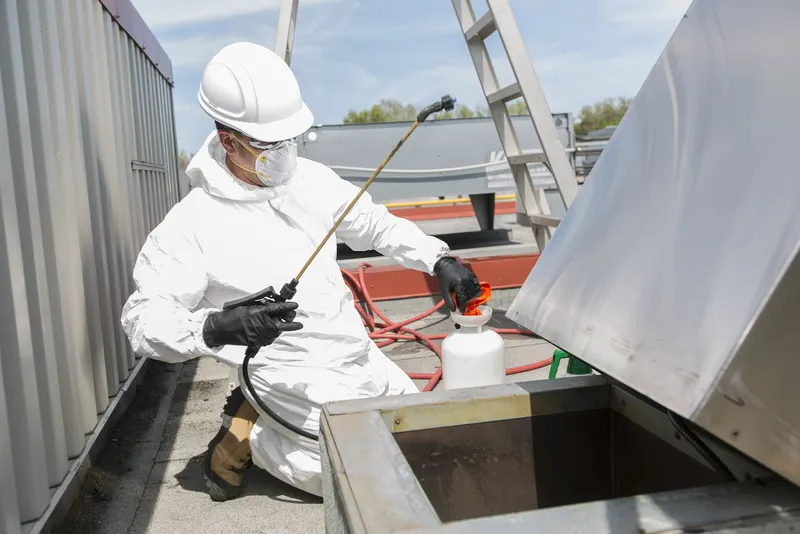
A hinge kit is sized to the curb and to the direction the fan has room to swing, and it usually goes on during a scheduled cleaning. The canopy side of that visit is described on the hood cleaning page, and the duct between hood and fan is on the kitchen exhaust cleaning page.
Rooftop grease containment and roof membrane damage
Rooftop grease containment is a tray or wrap with absorbent media that sits under the fan drain and catches grease before it reaches the roof.
An upblast fan discharges some grease with every cycle, and a drain spout on the housing sends the rest down the side of the curb. Most flat commercial roofs use a single-ply or built-up membrane, and grease softens both. The membrane blisters and splits, often right above the cook line. A containment unit with the media changed and photographed at each visit keeps the grease off the roof, and the photographs show the landlord that the tenant took reasonable care.
Winter roof access for exhaust fan repair in Waterloo Region
A fan that fails in January still has to be reached, and winter roof work in Waterloo Region needs planning.
Snow drifts against the curb and ice forms where the fan drain meets the roof. Before a winter repair, the crew clears a path from the roof hatch or ladder to the fan and checks the surface for ice around the drain. Tell us on the call how the roof is reached: an interior hatch, a fixed ladder, or a portable ladder from the lane. In a multi-storey building in Downtown Kitchener or Uptown Waterloo, the roof hatch may be controlled by a property manager, so the key has to be arranged before the visit. A single-storey kitchen reached by an exterior ladder is quicker to access but exposed to wind.
Best exhaust fan installation in Kitchener for a new cooking line
Exhaust fan installation is sized to the hood and the duct, not copied from the fan that was on the roof before.
A new line under a new canopy needs a fan that moves the airflow the hood was built for. An undersized fan leaves smoke in the kitchen. An oversized one pulls heated air out of the dining room all winter. Kitchener Hood Cleaning installs the fan on a new or existing curb with the hinge kit and containment fitted at the same time. Adding a charbroiler or a wood-fired oven changes how often the system has to be inspected, and the intervals by cooking type are set out in the NFPA 96 guide.
How much does exhaust fan repair cost in Kitchener in 2026?
Exhaust fan repair, replacement, hinge kits and rooftop grease containment in Kitchener are quoted per job after inspection, with the written quote back within 24 hours. For reference, a scheduled hood cleaning visit starts from $585 per visit for a single-hood kitchen up to ten feet.
The price depends on the fan size, whether it is belt or direct drive, and the state of the curb. Every service is listed on the services page.
Next step: call 226-407-0573 or request a written quote. A phone photo of the fan on its curb is often enough to identify the drive type and the hinge kit that fits.
Exhaust fan repair in Kitchener: frequently asked questions
Can the kitchen keep cooking while the exhaust fan is down?
A cooking line with no exhaust fan has no capture at the hood, so smoke and grease vapour stay in the kitchen. Most operators stop using the line under that hood until the fan runs again.
Who pays for the rooftop fan, the tenant or the landlord?
The lease decides. Many commercial leases put the fan with the tenant and the curb and roof membrane with the landlord, and the quote separates the two so each party sees its share.
Does a replacement fan have to be the same brand as the old one?
A replacement fan has to match the airflow the hood needs and the curb it sits on. The brand does not matter, and an undersized original is replaced with a correctly sized fan.
How long does a hinge kit installation take?
A hinge kit on a sound curb is usually fitted in the same visit as a cleaning, so it does not need its own night. The written quote states whether the curb needs work first.
How often should the grease containment media be changed?
The containment media is checked and changed at each cleaning visit, so it follows the same interval as the rest of the system.